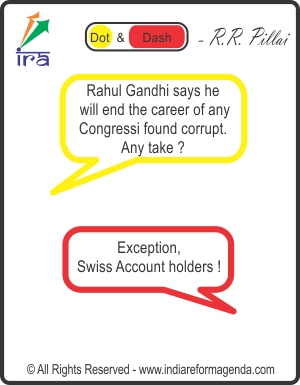
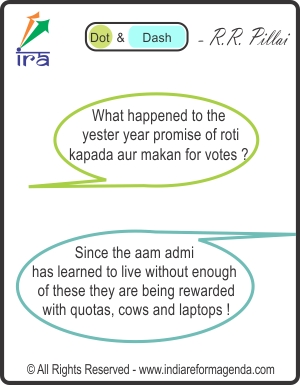
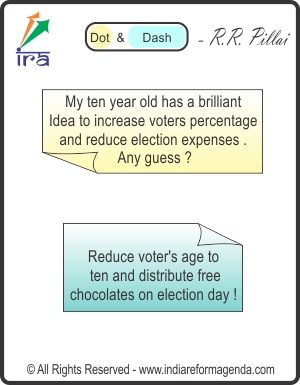
Dot and Dash Cartoons- My Ten Year Old
A scene in the village voter’s constituency during election time.
A poor old and tired villager in sitting on his hunches in front of his hut holding a long stick with one end firmly resting on the ground.
Under the thatched roof in front of his house are goodies like ; a bunch currency notes, a lap top, a TV, bottles of liquor, sari , utensils, baskets of fish and a goat and a cow tied to a pole next.
Caption: I wish continuous political instability. That’s the only way to achieve our inclusive growth target .
There are many Companies in India which carry a humungous cash reserves running into many times more than their need for entrepreneurial activities. For example Reliance Industries Limited and Coal India Limited . The Cash Reserves of RIL is around Rs75000 Cr. Even after utilizing around Rs 10000 Cr for the buy back of shares as recently announced it will still be left with a huge amount of nearly Rs 60000Cr in cash or cash equivalent. As the company’s recent income statement reveals quarter of the income is from treasury operations. That is lending money to earn interest. This led to many analyst wondering whether RIL is an energy major or finance Company.
Thus Companies earning a huge proportion of their income through treasury operations than through entrepreneurial activities needs to be disincentivised. One way can be to apply the whole sale price mechanism concept for large scale deposits in banks or corporate bonds. We all know that the whole sale price of fruits or vegetables are always lesser than what the ultimate retail buyers pay. Similarly banks must offer lower rates for deposits beyond a few crores. Since the banks are buyers of deposits on a wholesale basis when it comes to large amount of deposits they must get them at a lower rate than what they pay on a retail deposit of a few lakhs or a few thosand rupees of deposit.In short for the bankers too bulk buying of deposits should be at a lower rate. especially in our administered interest rate regime.
This will enable banks to buy money cheap on a large scale and lend money cheap to sectors which need them at a low cost. E .g . the power, transport, affordable housing sector small and medium enterprises, etc . Since interest rate is not yet fully market determined appropriate administrative policy measures can be put in place for this differential interest rate mechanism to become operational.
It would be quite a task to find at what base amount beyond which the low rate called the whole sale deposit interest rate will be applicable. But with due deliberations taking into account the need to incentivise savings the base deposit amount can be arrived at suiting to the nature and size of our economy.
Since india must keep up the pace of growth, cheap availabilty of finance is necessary condition for increased entrepreneurial activities. We have to move from the high cost low wage economy to a low cost living wage economy. If interest cost is high it discourages the genuine entreprenrurs from expanding their activities. which affects growth emloyment and income . Since we have to depend upon the domestic consumption story given the size of the population it is imperative that a latge section of our people afford the good and services given their low wage earnings to keep the momentum of consumption and growth.
Unless the large number of workers in the unopganised sector are able to enjoy goods and services at a low price the potential volume on the consumption front cannot be achieved.And low price can be obtained if the cost is lowered. If low interest loans are available it would translate into low cost goods and in turn will be available to consumers at a low price.
If the basic power sector gets the advantage of low cost finanse on a long term basis cost of generation of power will be lower, and cheap power to industry can reduce the cost of production at manufacturing industries. Thus every sector that has a multiplier effect in providing emloynent and income generation will get a boost and the econmy will continue to enjoy the domestic growth story through low cost low price strategy.
Since a large section of Indian consumers are in the unorganised sector earning only survival wage and not living wage affordability will be an issue for a long time to come. The wages in the organized sector too is not commensurate with the rising prices. In my college days in the sixties the basic food item vada sambhar in the popular Udipi hotel was available at fifteen paise. The entry level wages for clerical job in an organized bank then was Rs 300 p.m.. Today in the same hotel vada sambhar costs Rs 30 and the entry level wages in the organized sector is around Rs 15000. Prices of common goods have moved up by 200% while wage income has just moved by 50 times. This is the real bane of our high price low wage economy. Wages have not kept up with the prices. So how does then one is able to live in such low wage high price conditions. One answer is the large scale corruption and bribe income in the organised sector.
The lokpal bill may punish the corrupt but a large number of petty corruption will be done with if their income matches with the price level, if goods are made available at affordable price. Unless cost of borrowing is reduced goods can’t be produced at low cost.
It’s one more paradox in our economy that a billionaire company like RIL has thousands of crores of non entrepreneurial interest income at high rates at such huge volumes of cash deployment in securities and on the other consumers are paying high prices for the basic goods from their laboured income which is not even a living wage for majority.We must disincentivise large scale interest income earnings by monopoly like corporates and facilitate to move on to low interest rate regime by introducing a low interest rate for large scale deposits. India must move on from high interest rate regime to low one if we mean inclusive growth.